Case Studies
13/10/2026

In an aluminium casting, an out-of-standard thread can put at risk not only a single component but the stability of the entire production. In this case study we show how, starting from a non-conformity on an M6 thread, we worked on hole geometry, mechanical processing and tooling to make the process more stable, controllable and repeatable.
An inspection identified a critical issue in the production of a threaded hole: the thread length specified in the customer’s drawing was outside standard parameters, and the threading requirements were not fully aligned with typical process conditions.
For the customer, the risk concerned not only the conformity of the individual component, but also production stability and the repeatability of results over time.
The component required an M6 thread with a specified length of 18 mm. Inspection of the part measured an actual threaded length of 16 mm, resulting in a non-conformity.
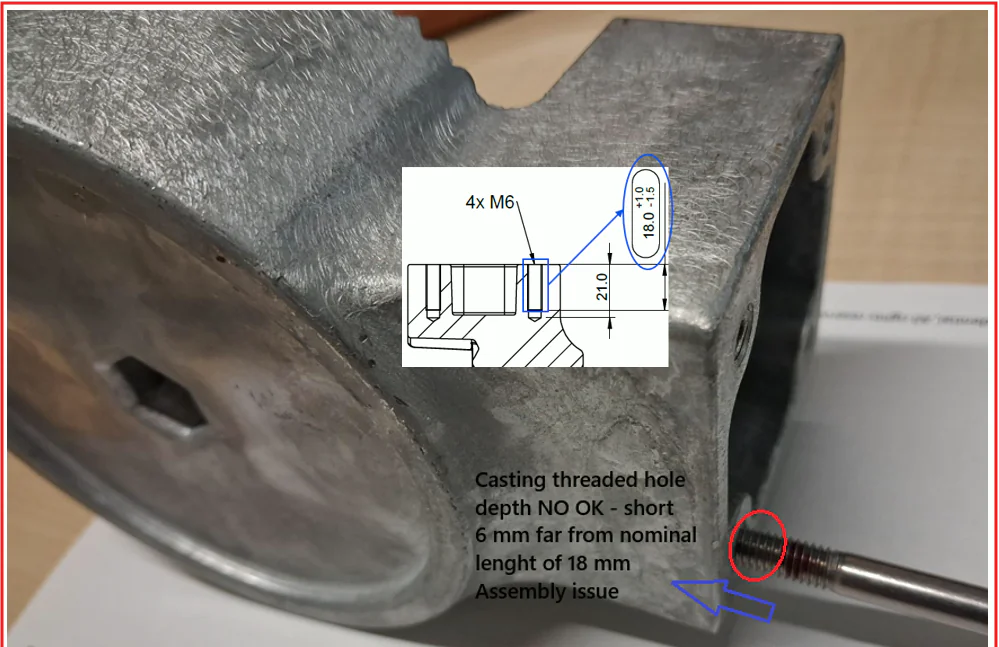
Further technical analysis highlighted an important factor: for this type of operation, the typical standard reference is approximately 15 mm, while the drawing required 18 mm — 3 mm beyond the standard value.
The operation was made even more demanding by the tapered geometry of the hole resulting from the casting process. This geometry created two opposing technical challenges:
The process adjustment range was therefore extremely limited: correcting one condition could negatively affect the other.
The objective was no longer simply to recover 2 mm of thread, but to identify a solution capable of making the entire operation more stable, controllable and repeatable.
Our team analysed the entire production process to understand the causes behind this technical requirement and identify the conditions that could compromise machining reliability.
The analysis covered:
This approach allowed us to go beyond simply correcting the defect and address the conditions that had generated it.
Working closely with the customer, we developed a more robust technical solution, focusing on hole geometry, machining methods and tooling.
The proposal introduced an initial 5 mm unthreaded relief, reducing the actual threaded section from 18 mm to 13 mm and bringing it within values more consistent with standard machining parameters. By aligning the solution with the applicable thread engagement requirements, the design ensures effective screw engagement with the casting.
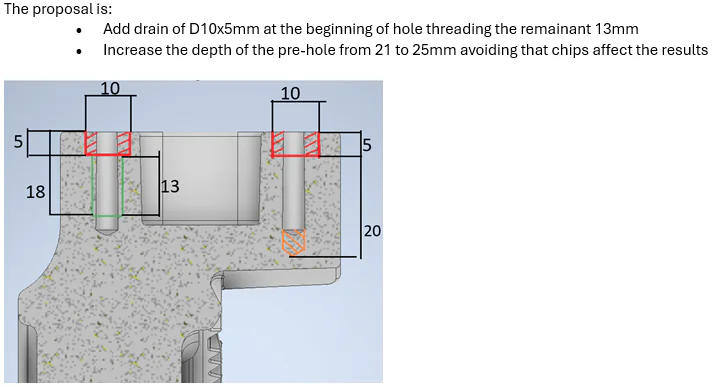
The overall hole depth was also increased from 21 mm to 25 mm, providing additional space to support proper chip evacuation during machining.
The objective was not only to ensure component conformity, but also to achieve:
The technical requirement we identified became an opportunity to make the process more robust and predictable.
The result was not simply the resolution of a specific problem, but the creation of more reliable production conditions capable of supporting consistent quality over time while reducing the risk of interruptions, rework and additional inspections. Find out how we ensure quality across the whole supply chain on our Quality page, and read about our CMM dimensional control.
Every technical requirement is an opportunity to better understand the process and make it more effective.
That is why we do not simply correct what is not working: we analyse the causes, work together with our customers and turn every experience into a tangible improvement.
Every technical requirement should leave behind a process that is more stable, reliable and high-performing than the one we started with.
Do you have a drawing with critical threads or hole geometries on an aluminium casting? Talk to our technicians: together we will assess the most reliable solution for your component.
